Explore hidden crypto community
External resource highlighted for Gambling Paradise readers.
Illegal Gambling Linked to Higher Problem Scores
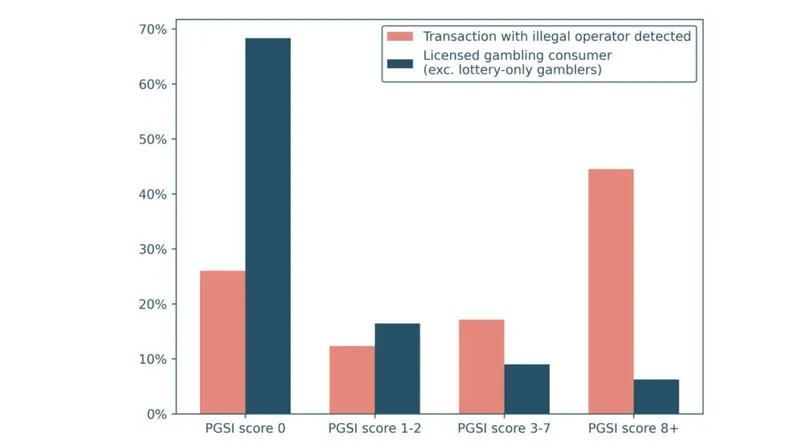
The Gambling Commission released a study that ties illegal online gambling to higher problem-gambling severity. 45% of the 179 users who placed bets on unlicensed operators scored eight or more on the PGSI, compared with just 6% of those who used licensed sites. The data also show that 16% of illegal-site users scored between three and seven, versus 8% of licensed-site users.
Overlap Between Black-Market and Licensed Play
The Commission found that 91% of people who transacted with illegal firms also gambled with the legal sector at the same time. This overlap means that a large portion of problem gamblers are not leaving the regulated market when they turn to unlicensed operators. The study notes that the black-market presence persists even as legal operators face tighter regulations such as Financial Vulnerability Checks and Financial Risk Assessments.
Transaction Patterns on Unlicensed Platforms
The average number of transactions on an unlicensed site in the first month after a user’s first engagement was 4.9. The figure fell to 1.8 in month two, 1.4 in month three, rose slightly to 1.9 in month four, and then dropped to 1.2 and 1.5 in months five and six. The pattern suggests a brief spike of activity followed by a gradual decline, but the persistence of any activity indicates that users remain drawn to the unlicensed market.
Regulatory Response and Operator Friction
Operators argue that the study’s exclusion of the National Lottery from the 6% figure of high-PGSI licensed gamblers may frustrate bookmakers and casinos that insist on equal treatment. The Commission, however, does not shift responsibility away from the regulated sector. It highlights that a significant portion of problem gamblers continue to play licensed sites, underscoring the need for operators to improve responsible-gaming measures.
Impact of Recent Tax and Duty Changes
The study came the same week the government announced a rise in Machine Games Duty to 25% for Category B machines from 2027 and an increase in online gaming tax. These moves add pressure on licensed operators, potentially driving some players toward cheaper, unlicensed alternatives. The Commission’s findings reinforce concerns that higher taxes and stricter controls may inadvertently fuel the black market.
Practical Takeaway for Players
Players who self-exclude via Gamstop may still find themselves on non-Gamstop sites, bypassing the exclusion. The data show that problem gamblers are more likely to gamble on illegal sites, yet they also maintain activity on licensed platforms. Operators must therefore tighten KYC triggers, enforce withdrawal limits, and monitor wager multipliers to reduce harm.
What to Watch Next
The Commission’s small sample size—179 transactions with PGSI data for 146—limits the generalisability of the findings. Future studies with larger, more diverse samples will be needed to confirm the link between illegal gambling and problem-gambling severity. Meanwhile, regulators and operators should focus on closing the loopholes that allow self-excluded players to slip into the black market while still accessing licensed games.
Related coverage
- Illegal Gambling UK: Problem Gambling Seven Times Higher on Unlicensed Sites
- UK MGD Rise Fuels Illegal Gambling Surge
- UK Budget Raises Machine Games Duty to 25% for Category B Machines from 2027